Healthy Active Rural Tennessee (HART) Grant
The Tennessee Department of Health’s Healthy Active Rural Tennessee (HART) grant is a major new funding opportunity focused on improving health outcomes through “built environment” projects in rural and suburban Tennessee communities. The program is funded through the federal CMS Rural Health Transformation initiative and is designed to support projects that encourage physical activity, healthier lifestyles, community resilience, and access to health-promoting spaces.
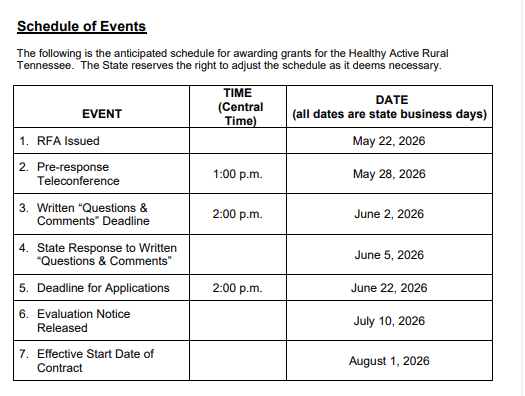
The state has set aside $20 million total for HART projects through 2031, with this initial procurement making $6 million available for approximately 48–120 projects. Eligible applicants include 501(c)(3) nonprofits, local and state governments, and tribes. Projects must serve one of Tennessee’s 89 eligible rural/suburban counties (all counties except Shelby, Madison, Davidson, Hamilton, Knox, and Sullivan). Grants are expected to range up to $100,000 for a single phase or $150,000 for combined planning and implementation projects. Contracts are anticipated to run from August 2026 through June 2028.
The grant is especially notable because it funds both planning and implementation-oriented activities. Phase A supports convening stakeholders, conducting assessments, and developing plans such as greenway master plans, complete streets plans, public space plans, and active transportation strategies. Phase B funds tactical or placemaking projects such as temporary bike lanes, murals, community gardens, outdoor fitness features, signage, park enhancements, and other low-cost interventions that improve public health without major construction.
For Tennessee nonprofits generally, this opportunity is highly relevant because it intentionally encourages community-based partnerships and grassroots engagement. Organizations working in public health, behavioral health, parks and recreation, community development, food access, housing, placemaking, transportation, youth services, aging, disability advocacy, and economic development could all be strong applicants or partners. The scoring criteria heavily reward projects that demonstrate community engagement, partnerships, sustainability, measurable outcomes, and service to high-poverty or underserved populations.
The grant is also structured in a way that makes it accessible to nonprofits that may not traditionally pursue infrastructure funding. Importantly, HART does not require matching funds, although in-kind support and partnerships strengthen applications. However, funds are reimbursement-based only, meaning organizations must front costs before reimbursement, which could be challenging for smaller nonprofits without strong cash flow. The RFA also prohibits spending on food, major construction, or capital purchases, meaning applicants should focus on planning, activation, beautification, tactical urbanism, and enhancements to existing assets rather than large infrastructure builds.
Strategically, this opportunity aligns well with broader Tennessee priorities around rural health transformation, preventive health, obesity reduction, behavioral health, and social determinants of health. It creates a pathway for nonprofits to position themselves as community conveners and implementation partners in rural development conversations that have historically been led primarily by local governments or transportation agencies. Organizations with strong local relationships and the ability to document community need using health and poverty data will likely be especially competitive.